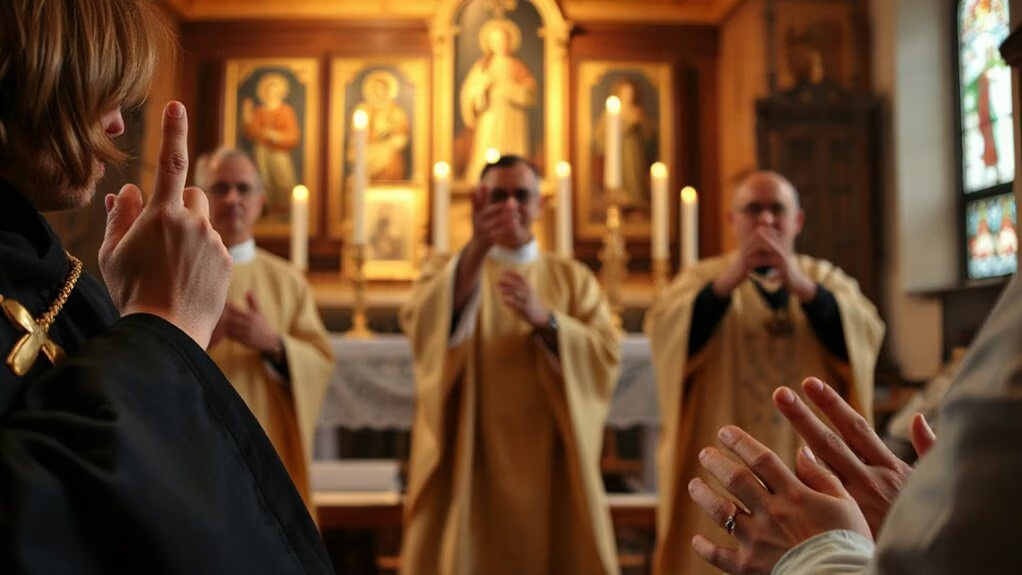
The Sign of the Cross — the ritual gesture tracing the shape of a cross on or before the body — is among the oldest and most widespread practices in Christian tradition, with attestation in Christian writings from as early as the second century AD. Tertullian, writing around 200 AD, described Christians of his time marking their foreheads with the cross as a routine part of daily life. Over two millennia, the practice has diversified across denominations and cultural traditions into a range of distinct forms, each carrying specific theological and devotional meaning.
Understanding the different forms of the Sign of the Cross is not only an exercise in religious history — it is an entry point into the profound theological differences and shared devotional instincts that characterise the extraordinary diversity of global Christianity. Here are seven significant forms.
1. The Roman Catholic Form: Left to Right
In the Roman Catholic tradition (and in most Western Christian churches), the Sign of the Cross is made by touching the forehead, then the chest (or lower sternum), then the left shoulder, then the right shoulder — while saying “In the name of the Father (forehead), and of the Son (chest), and of the Holy Spirit (left to right), Amen.” The movement is typically made with the fingers and thumb held together or with the open palm.
The left-to-right horizontal movement is the defining characteristic of the Western form. This direction was codified in the medieval Western church, though the theological significance attributed to the specific direction varies by source — some commentators associate the movement toward the right with the scriptural placement of the blessed at the right hand of God; others treat it as simply a traditional convention.
The gesture accompanies numerous moments in Catholic liturgy: at the beginning of Mass, at the reading of the Gospel (three small crosses on forehead, lips, and heart), before and after prayer, at the reception of blessings, and as a part of many personal devotional practices. It is the most widely recognised form of the gesture globally, given the size of the Catholic Church.
2. The Eastern Orthodox Form: Right to Left
In Eastern Orthodox Christianity — including the Greek Orthodox, Russian Orthodox, Serbian, Romanian, and other Orthodox churches — the Sign of the Cross is made in the opposite horizontal direction: forehead, chest, right shoulder, left shoulder. It is also typically made with the thumb and first two fingers pressed together (representing the Trinity) and the remaining two fingers folded down (representing the two natures of Christ: divine and human). This specific finger position — the “Orthodox cross” hand — is itself a theological statement embedded in the gesture.
The right-to-left direction is documented in Orthodox sources as ancient practice and is theologically associated with several interpretations: moving from right (the blessed, the place of honour) to left (the condemned), symbolising Christ’s movement from glory into the world of sin; or simply reflecting the earlier practice before the Western church standardised in the opposite direction. The Orthodox and Catholic traditions diverged on this point sometime during the medieval period.
In Orthodox liturgy, the Sign of the Cross is made with great frequency — many dozens of times during a full Divine Liturgy — and with pronounced reverence and deliberateness. It accompanies not only prayer but also the veneration of icons, the reception of Holy Communion, and many moments of daily devotion.
3. The Eastern Catholic Form: Right to Left With Western Affiliation
Eastern Catholic churches — those in communion with Rome but maintaining Eastern liturgical rites (Byzantine, Coptic, Syriac, Armenian, Maronite, and others) — generally retain their historic Eastern practice of signing from right to left, with the Orthodox-style finger position. This is one of the most visible reminders that Eastern Catholics, despite full communion with the Pope, maintain distinct liturgical identities that predate the Great Schism and are preserved as a matter of both theology and cultural heritage.
The preservation of Eastern signing practice in Eastern Catholic churches reflects a broader principle: that full communion with Rome does not require liturgical uniformity, and that the diversity of apostolic traditions within Catholicism is itself considered theologically significant.
4. The Small Cross — Thumb on Forehead, Lips, and Heart
Before the reading of the Gospel in Mass, Catholic and many Anglican worshippers make a distinctive triple gesture: a small cross with the thumb on the forehead, the lips, and the heart (or chest), accompanied (usually internally) by the prayer “May the Word of God be in my mind, on my lips, and in my heart.” This gesture traces three small crosses rather than one large one and is made specifically as a preparation for hearing the Gospel proclaimed.
The theological meaning is explicit in the accompanying prayer: the gesture is a commitment and an aspiration — that the Word heard will not be received passively but will penetrate the mind, shape the speech, and transform the heart. It is one of the few versions of the Sign of the Cross that comes with an accompanying verbal formula that makes its meaning transparent to the practitioner.
5. The Coptic and Ethiopian Orthodox Form
The Coptic Orthodox Church (Egypt) and Ethiopian Orthodox Church maintain their own ancient signing practices. Coptic Christians typically make the sign with the right hand, touching forehead, chest, left shoulder, right shoulder — the same direction as Latin Catholics — but the gesture is often accompanied by a deep bow and is made with notable solemnity. In the Ethiopian Orthodox tradition, the signing practice is closely associated with the full body prostrations that characterise that tradition’s particularly physically expressive liturgy.
Both traditions claim apostolic foundation — the Coptic Church traces its origins to the Evangelist Mark, and the Ethiopian Church to the Apostle Philip’s baptism of the Ethiopian eunuch in Acts 8. Their liturgical practices reflect this ancient, independent lineage distinct from both Rome and Constantinople.
6. The Anglican and High Church Protestant Form
Within Anglicanism, practice varies significantly across the theological spectrum. High Church and Anglo-Catholic Anglicans typically make the Sign of the Cross in the Roman Catholic manner, as part of a broader adoption of Catholic ceremonial practices. This includes making the sign at the Gloria, at the Creed, at the Gospel, and at the final blessing in the Eucharist. In Anglo-Catholic parishes, the practice may be largely indistinguishable from Roman Catholic use.
Low Church and Evangelical Anglicans typically do not use the Sign of the Cross in corporate worship, viewing it as an unnecessary or potentially superstitious addition to Scripture-based worship. This divergence reflects the broader internal theological range within Anglicanism — a tradition that has historically contained both Catholic and Protestant tendencies within a single church.
Among Lutherans (particularly in Scandinavia and high-church Lutheran communities), the Sign of the Cross is also maintained in liturgical use. Luther himself retained it and wrote positively about its value as a reminder of baptism and as a physical anchor for prayer.
7. The Blessing Cross — Priest’s Form
When a priest or bishop makes the Sign of the Cross over others — in blessing — the gesture has a distinct theological character from the personal Sign of the Cross. In the Western tradition, the priest blesses by making the cross in the air over the person or congregation, typically with the right hand. In the Eastern tradition, a priest’s blessing hand forms a specific configuration of the fingers that, viewed from the front, traces the Greek letters IC XC — the abbreviation of Jesus Christ in Greek — as the hand moves. This “blessing cross” is therefore not just a gesture but a living monogram of the name of Christ.
The priest’s blessing cross in Orthodoxy is sometimes made over objects as well as people — water, food, icons, buildings — in the context of sanctification prayers. The gesture in this context draws directly on the New Testament practice of blessing through the laying on of hands and is understood not as the priest’s own power but as the transmission of divine blessing through an ordained mediator.
The Common Thread: Embodied Theology
Across all of these diverse forms, the Sign of the Cross represents a shared Christian instinct: that theology should be embodied, not merely believed. The gesture makes the body a participant in faith, not merely a vehicle for the mind. It marks the person as belonging to Christ. It is a physical memory of baptism. And it is, in almost all traditions, an act of trust — an acknowledgement that the person stands under the cross that Christian theology places at the centre of meaning and history.
The divergences in form — left to right, right to left, fingers together, fingers spread — are less significant than the shared conviction that gesture matters, that the physical and spiritual are not separate domains, and that Christian identity is something to be inscribed on the body as well as held in the mind.
⚠ Disclaimer
The information provided on this website is for general informational and educational purposes only. It is not intended as, and does not constitute, medical, psychological, legal, or professional advice. Always consult a qualified healthcare provider, licensed therapist, or other appropriate professional before making any decisions based on the content of this site. SignsOf.org does not endorse any specific treatment, product, or course of action. Reliance on any information on this site is solely at your own risk.
Post Disclaimer
The information contained in this post is for general information purposes only. The information is provided by 7 Forms of the Sign of the Cross: Christian Traditions Explained and while we endeavour to keep the information up to date and correct, we make no representations or warranties of any kind, express or implied, about the completeness, accuracy, reliability, suitability or availability with respect to the website or the information, products, services, or related graphics contained on the post for any purpose.